
Friday, 20 June 2014
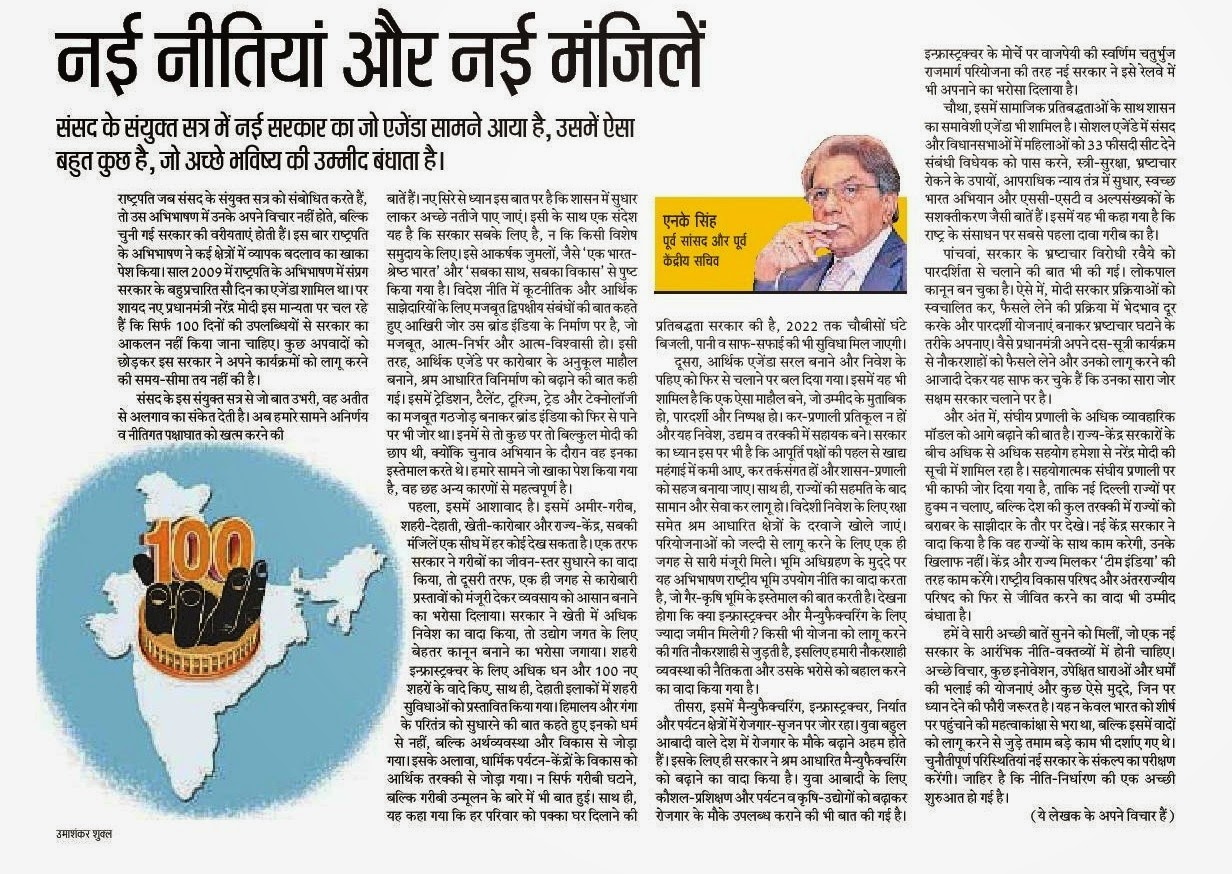
नई नीतीयां और नई मंजिलें

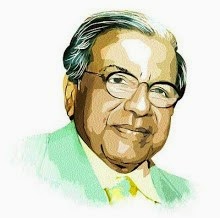 Former IAS Officer & Principal Secretary to PM Vajpayee. So far written two books on economics and politics.
Friday, 7 March 2014
The Lost Decade
The Model Code of Conduct has come into
effect. This effectively marks the end
of UPA II. This is a good time to
reflect on the 10 years of the UPA government.
For India this could be a Lost Decade.
The term ‘Lost Decade’ was initially used in the context of the Japanese
stagflation beginning the 90s. In a
broader sense ‘Lost Decade’ implies not only meager achievements but lost
opportunities. At best a combination of both. These ten years, notwithstanding
acts of terrorism and insurgencies in some parts of the country, largely
remained free from any major war or debilitating natural catastrophe. The UPA I had inherited 15 years of
continuous economic reforms, a significantly higher growth threshold and India
as a favoured global destination. It would have been reasonable to expect that
building on these achievements would be reflected in continuing the growth
momentum and a governance fabric which would strengthen our confidence.
There have been modest achievements in
strengthening social security systems by way of entitlement driven Welfarism.
These include the MNREGA, Right to Education and Food Security. Ofcourse while
India’s problems are unique. No other
country at this level of per-capita income has undertaken entitlement driven Welfarism
of this new kind. Economic growth rates during the UPA-I was an average of 8.4%
benefiting greatly from the foundations laid during the NDA regime. This
notwithstanding the fact that a meager 2.7 million jobs were created during the
five years of UPA-I compared to 60.7 million jobs in the preceding five years
under NDA. However, the UPA II saw tapering off of growth to an average 6.2%, (now sub 5%)severe macro-economic weaknesses
with widening fiscal deficit and sagging investor confidence attributed
significantly to internal than exogenous
factors. Rekindling ‘Animal Spirits’, a familiar term
in behavioral economics, covers a wide range of human action in which action is
not wholly a rationally driven economic plan.
Alan Greenspan in his new book “The
Map and the Territory: Risk, Human Nature and the Future of Forecasting” describes the propensities of fear and
euphoria, risk aversion and time preference influencing savings as central to
the psychological underpinnings of economic analysis. The growing lack of trust,
a pervading milieu of financial malfeasance, a largely dysfunctional
Parliament, overzealous courts and constitutionally mandated institutions treading
grey areas in relation to their mandate has smothered any early rekindling of
the Animal Spirit. Retrospective changes in tax laws and an aggressive tax
department has prompted foreign
investors to even question whether we believe in the rule of law. Entrepreneurs are caught in disputes with regulatory and enforcements
institutions with little inclination to pursue fresh investments. India has ceased to be a favoured investment
destination. Entitlement driven welfarism and misalignment
of wage rates with productivity has made gainful economic activity increasingly
uncompetitive. This is not a milieu in
which industries globally seeking relocation would opt for India. Ironically Indians increasingly seek
investment opportunities elsewhere.
As this government signs off on a Lost
Decade it leaves behind enormous challenges both psychological and real for its
successor. These would include the
following:
First, restoring trust in the governance
fabric. This implies an orderly
functioning of the Legislature, implementing long delayed judicial reforms and
an executive which feels empowered to take bonafide decisions.
Second, to review many laws whose
implementation remains flawed with dubious outcomes. Given the populist nature of these measures
it may be difficult to repeal them. A creative restructuring could enhance
growth and restore our competitiveness.
Third, putting the house in order. Achieving
fiscal targets by suppressing capital expenditure, postponing identifiable outgoes
to subsequent periods, taking credit for unlikely revenue buoyancy is not
credible. The recent Article IV
consultations of the International Monitory Fund (IMF) highlights the flawed
arithmetic or more charitably the “creative accounting engineering”. Regrettably as John Maynard Keynes had said,
“The boom, not the slump, is the right
time for austerity at the Treasury.”
Fourth, restoring
the health of financial institutions. It
is common knowledge that the suspect assets of banks are far deeper than the
superficial numbers on Non Performing Assets.
Providing a meager Rs 11,200 crores in the recent budget is a gross
understatement. Far greater infusion of
capital would be necessary or the banks encouraged to seek market
borrowings. This requires a legislative
change which while initiated by the NDA Government remained incomplete.
Fifth, creating gainful employment
opportunities to reverse the expectations of the Young. This requires a genuine revival of the
manufacturing sector which for the two years has shown zero growth rate. A rethink on the regulatory framework
particularly labour laws, creation of urban conglomerate, re-location of labour
from agriculture to alternative occupation pattern is inescapable.
Last but not the least reviving our self
confidence is central to rekindling the Animal Spirit. Deep skepticism embedded
in frustration has encouraged new experiments in Governance. These could disrupt social compact and
cohesion.
There is expectation that the sagacity
of the Indian people will provide a strong and stable government. More
importantly a credible leadership which can replace the Lost Decade with a Decade
of Rejuvenation. And as Martin Luther King had said, “A genuine leader is not a
searcher for consensus but a molder of consensus”.
Former IAS Officer & Principal Secretary to PM Vajpayee. So far written two books on economics and politics.
Friday, 17 January 2014
Wither Education?
The Prime Minister’s recent press conference, the last, judging by track record is almost forgotten. He mentioned the importance of education and that “We have transformed the educational landscape of our country”. Some strides have no doubt been made. The Right to Education Act is designed to guarantee access and make primary education compulsory and free of cost. In actual practice there are serious implementational issues and the Act was neither well thought through nor well designed. In fact it upset the set equilibrium between the role of the State and private schools without offering credible alternatives. This is well brought out in the Annual Status of Education Report (ASER), 2013 conducted by PRATHAM, two days ago. This is the thirteenth Annual Report based on acceptable methodology and conducted carefully through household surveys is perhaps the most credible analytical report. It has covered 550 districts and close to 16,000 villages, 3.3 lakh households and 6 lakh children in the age group of 3 to 16. The Annual Report which commenced in 2005 has emerged as the most reliable index on educational outcomes. The key findings of the report are:
· The enrolment level in schools has made significant strides with 97% of children now in schools, compared with 93% in 2005 reflecting a good progress compared to enrolments in the previous years.
· The percentage of girls in the 11 to 14 years age group not going to schools has declined from 17.6% in 2006 to 5.5% in 2013.
· There has been a steady increase in private school enrolment from 18.7% in 2006 to 29% in 2013. In states such as Manipur and Kerala, nearly 70% of the students are in private schools and states such as Uttar Pradesh and Haryana, the proportion is close to 50%.
· In states where enrolment in government schools is high, a higher portion of students were found to depend on private tuitions to supplement what they learnt in school. For example, in Bihar and Odisha, where only 8.4% and 7.3% of students are in private schools, respectively, 52.2% and 51.2% of students were taking private tuitions.
· The quality of learning- as measured by reading, writing, and arithmetic—has either shown no improvement or actually worsened in the last nine years.
· While three out of every five students in standard 5 were able to read the text books prescribed for pupils who were three years junior in 2005, only one out of two is up to the task now.
Notwithstanding a somewhat depressing overall picture to educational outcomes, there are pockets of optimism. The percentage of girls in the 11 to 14 years age group not going to school continues to be high in Rajasthan and Uttar Pradesh but it has sharply declined in Bihar. In terms of learning levels states like Kerala, Himachal Pradesh, Haryana and Punjab have done exceptionally well in comparison to Assam, Chhattisgarh, Gujarat and Tamil Nadu. Surprisingly, the State of Bihar has done much better in comparison with the advanced states. Bihar has also done well on the school infrastructure front. The percentage of schools in Bihar with no drinking water facility has declined from 9.6% in 2010 to 4.1% in 2013. In 2010, only 18.1% schools had a separate toilet for girls. It has increased to 47.6% in 2013. Clearly, Bihar emerging from years of neglect has shown outstanding progress.
The ASER Report presents a dismal picture of the quality of school education in India. The rising enrolment figures can be attributed to the success of SSA and the MDM schemes but efforts to expand enrolment must be accompanied by improved quality of education with quality improvement in teacher training and development of curricular materials. There are at least six areas of concern as far as quality of school education in India is concerned.
First, schedule of norms and standards. The spirit of RTE clearly intends ‘education’ to go beyond access and guarantee learning for all. The law only specifies the inputs that should be present in schools in the form of buildings, facilities and teachers rather than outcomes that children should be guaranteed in the form of specific learning benchmarks. Certain norms regarding infrastructure, number of teachers per school and per student, educational outcomes and teaching methods must be adhered to as necessary conditions.
Second, shortage of teachers is one of the key constraints. New schools, materials and incentives will do little unless there are new teachers to undertake teaching. PPPs emerge as a viable alternative to improve access to quality school education while ensuring equity.
Third, the quality of teachers. It is estimated that about 7 lakh teachers do not have the qualifications prescribed by the National Council for Teacher Education (NCTE). The RTE Act provides for a period of five years within which all teachers should acquire the prescribed qualifications. It is important to lay down well-defined but flexible norms for the minimum qualifications of teachers.
Fourth, supply side deficiencies. The mushrooming of private educational facilities in the recent years reflects the ever-increasing demand for educational service on the one hand and the state’s inability to provide quality education on the other. Competition between the government and private schools need to be encouraged through innovative measures like school coupons.
Fifth, insufficient expenditure in education. The Plan allocation for school education has seen only a 10 percent increase over last year. But the actual allocation is only a third of what should have gone for Sarva Shiksha Abhiyaan. Since the Government does not have the financial resources to achieve the goals, it must enable the right framework to attract private capital and global body-of-knowledge to make up for the deficit.
Finally, Public Private Partnerships have become an accepted norm in most of the developed and progressive nations who have realized the need for involving the private sector because of the escalating costs of education. There has been a steady increase in private school enrolment in India. In states such as Manipur and Kerala, nearly 70% of the students are in private schools and in states such as Uttar Pradesh and Haryana, the proportion is close to 50%. This is in sharp contrast to Bihar where even though the private schools are increasing their presence the State schools remain the main stay of education. This could be either mean absence of choice or alternatively that the State schools are better run in Bihar than in some other states.
The ASER Report 2013 is a wakeup call in education particularly on educational outcomes. Traditional methods of teaching and reliance on text books need re-thinking. Innovative solutions suited to local conditions must be explored. Unless educational outcomes improve, the Prime Minister’s claim will remain shallow. While not much can be expected in the last months of the UPA Government, India’s educational challenge will remain the new government’s highest priority. Improving educational outcomes has a direct bearing in reducing poverty. It must be at the heart of our economic strategy.
Former IAS Officer & Principal Secretary to PM Vajpayee. So far written two books on economics and politics.
Thursday, 8 September 2011
Against the foodgrain
 Former IAS Officer & Principal Secretary to PM Vajpayee. So far written two books on economics and politics.
Subscribe to:
Posts (Atom)